




“The teams that win will be the ones who can read which wave is coming and move before it breaks.”
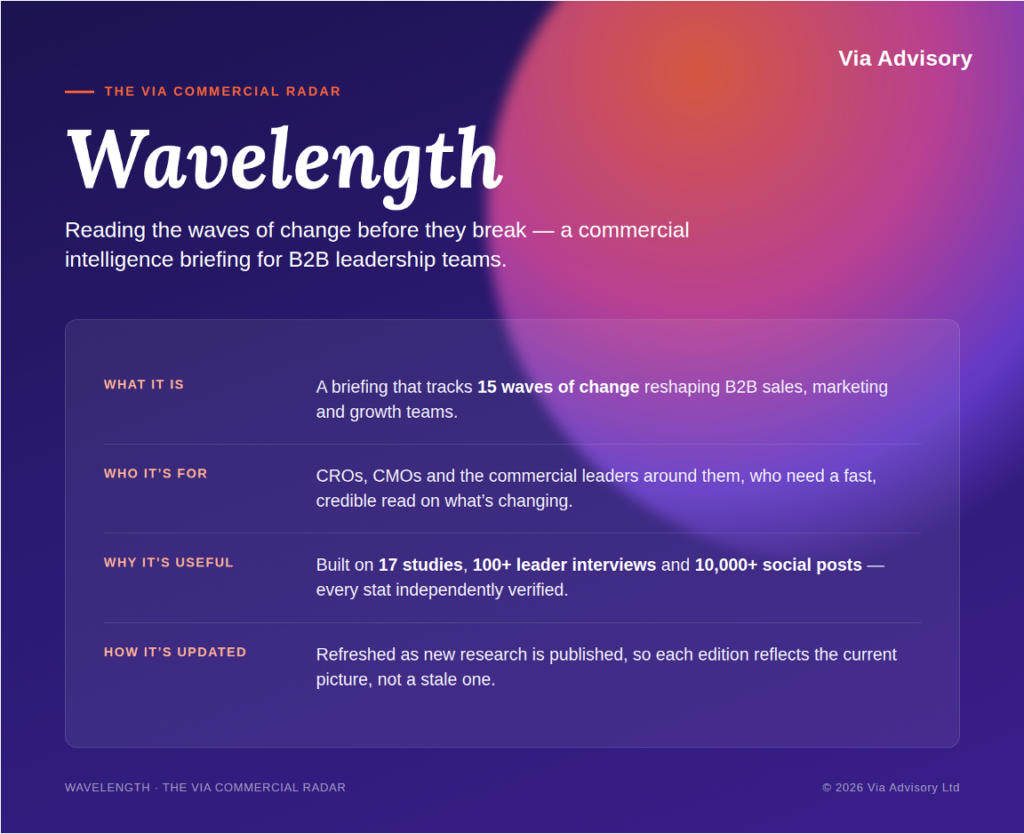
The Via Commercial Radar tracks the waves of change happening across each function of a B2B business, spanning sales, marketing, customer experience, and growth teams. For the executive leadership teams, it helps prioritise based on what is already reshaping today, what is close enough to demand a decision now, and what is still forming on the horizon.
Methodology
The Radar draws on 17 studies from Bain, Forrester, Gartner, PwC and others, over 30,000 combined survey participants, 100+ interviews with senior commercial leaders across six B2B sectors, and 10,000+ social posts analysed. Published September 2026.
Why it matters – the waves of change
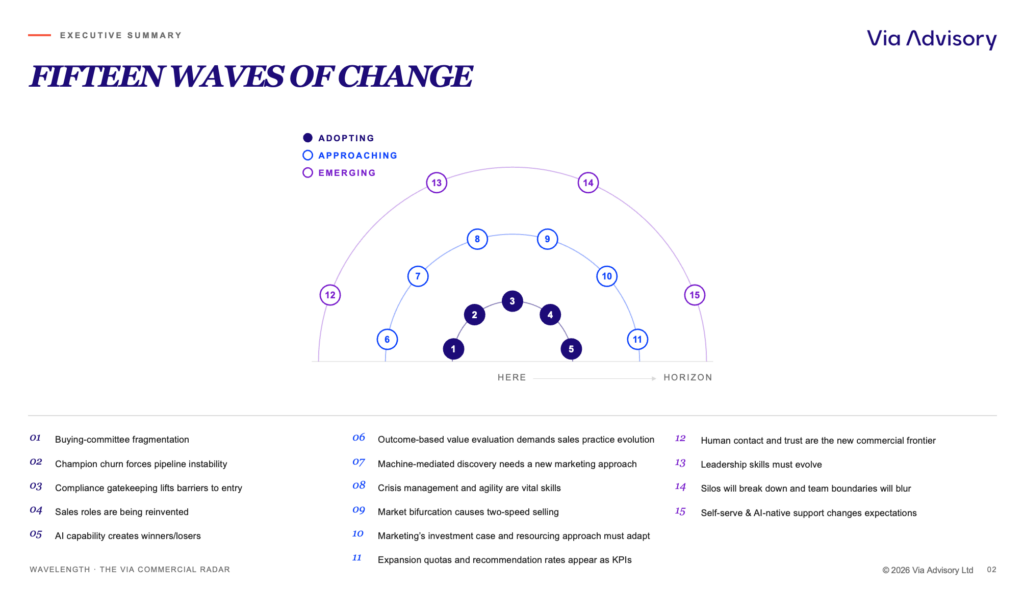
Most commercial functions underperform because they lack clarity and alignment, not because they lack people or activity. This Radar sorts each shift by proximity:
- Adopting: already reshaping pipeline today)
- Approaching: close enough to demand a decision now)
- Emerging: forming on the horizon).
Adopting: already on your desk
Buying-committee fragmentation.
The single economic buyer has given way to a committee spanning procurement, security, finance and legal. 74% of buying teams show unhealthy conflict during the decision.
Champion churn forces pipeline instability.
Job mobility means the internal advocate driving a deal can leave mid-cycle. Multi-threading is now an account-planning requirement, not a nice-to-have.
Compliance gatekeeping lifts barriers to entry.
Security, ESG and AI-policy proof now qualify a supplier before pricing gets discussed. 53% of procurement professionals act as decision-makers for more than half the buying cycle.
Sales roles are being reinvented.
AI is taking over the qualification work that used to justify a rep's seat at the table. What remains is judgement: diagnosing a genuinely difficult buying situation and shaping a solution to it.
AI capability creates winners and losers.
Leaders who redesign workflows around AI are growing faster than those who bolt tools onto unchanged processes. Adoption alone explains little; orchestration explains the gap: 44% of leaders use generative AI against 22% of laggards.
Approaching: decisions needed now
Outcome-based value evaluation demands sales practice evolution.luation demands sales practice evolution. Feature advantage has a short shelf life: 80% of features are copied within six months. Buyers now reward proof of outcome and impact over product claims.
Feature advantage has a short shelf life: 80% of features are copied within six months. Buyers now reward proof of outcome and impact over product claims.
Machine-mediated discovery needs a new marketing approach.
Buyers research and shortlist through AI answer engines before a seller ever hears from them. 90% of Google searches now return a generative result, so visibility inside the answer matters more than ranking on the page.
Crisis management and agility are vital skills.
Reputational damage now spreads faster and reaches further. 84% of B2B tech CMOs have no plan to protect reputation in a crisis.
Market bifurcation causes two-speed selling.
Within the same sector, AI-linked accounts are accelerating while adjacent segments stall. Treating a market as one uniform opportunity misallocates go-to-market investment.
Marketing's investment case and resourcing approach must adapt.
Short-term campaign spend is quietly starving the long-term demand it depends on, while the Chief Marketing Officer role carries the lowest perceived boardroom weight of any C-suite seat.
Expansion quotas and recommendation rates appear as KPIs
Renewal, expansion and recommendation are becoming quota-bearing targets in their own right. 92% of B2B buyers with a shortlist already on it will purchase from that list.
Emerging: forming on the horizon
Human contact and trust are the new commercial frontier.
As AI absorbs routine interaction, a genuine human conversation becomes the differentiator buyers actively seek out, not the default they expect.
Leadership skills must evolve.
With fewer juniors coming through and the tools shifting constantly, leading a commercial team now means setting direction and orchestrating work, not managing tasks. Fewer than half of CEOs are confident they have the right people in the right roles.
Silos will break down and team boundaries will blur.
Shared AI-driven programmes such as ABM expose what sales and marketing have long left unresolved: 51% of sales leaders report fundamental disagreement with marketing on lead quality.
Self-serve and AI-native support changes expectations.
Consumer-grade convenience is now the baseline for B2B buyers, not a discount option. 73% are comfortable spending more than $50,000 through a self-service tool.

Wavelength – released: October 2026
No forms, no hassle.
Download wavelength now here.
It is designed to be easy to use in your own presentations, and to share amongst different members of your team.
We’d welcome any feedback or any trends you think we’d missed – just contact us with your thoughts.